You're Selling Luxury Design Like Walmart Sell Carrots

Most designers starting a fashion brand are trying to sell products.
They design a garment, price it, photograph it beautifully, post it on Instagram and wait… and wait…
When the sales don’t come… or worse…. People say “It’s lovely but I can get it cheaper in Zara or H&M”…. they either go back to the drawing board and design another… and another.
Or, they lower their prices, lowering the perception of their brand and unable to survive the low margins, so they usually end up closing down in less than a year.
It’s not the designers’ fault. You were never taught this in fashion school, but to succeed as a fashion brand it’s something you must understand.
What separates the designers who are consistently filling waitlists and selling at high prices from those who struggle to sell just a handful of underpriced pieces is this:
They aren’t just designing a product…. A product is a commodity, something that people can compare prices and substitute for something else cheaper.
Wh...
The Fashion Brand Launch Strategy Everyone's Still Getting Wrong
Talented independent designers are pouring their heart and soul into their online presence... cringing as they create behind the scenes founder videos, posting 3 to 5 times a week on Instagram, hiring social media managers, running ads... and still wondering why nobody's buying.
If that's you, here's what's actually happening, why it's happening, and what's working instead.
Social media alone stopped working as a fashion brand launch strategy a long time ago. The platforms are saturated, the algorithms favour entertainment over craftsmanship, creativity and intellectual design, and your potential customer has scrolled past a thousand beautifully shot product videos before she's even finished her first coffee.
And yet, sign up for almost any fashion business coaching programme, watch almost any webinar aimed at independent designers, or follow any fashion mentor on Instagram and you'll still hear the same advice delivered as if it's cutting edge: post daily to Instagram, get on TikTo...
Some fashion designers are exploding right now… and the ones who aren't are all making the same mistake.
I was recently in California with a few days free before an event… so I used the time to talk to some fashion founders. And I noticed something quite consistent.
They were all incredibly talented designers with some early success behind them… but their visibility was stuck at the same level. Not enough to be profitable, and they didn't know how to reach the right people, who would genuinely appreciate their craftsmanship and pay what their work was worth, without comparing their prices to Zara or H&M.
They wanted more of the right people to see their collections. But the actions that would actually create that visibility kept getting pushed into the 'I'll do it later' category.
There's always something more immediate… production, admin, finances. running the studio, life. So the work that actually changes how a brand is seen keeps getting pushed to tomorrow… next week… after this deadline… after production… once the collection is ready.
What most designers don't realise is that ...
5 Mistakes Talented Fashion Designers Make That Cause Your Collection To Be Forgotten The Day After Your Launch
You poured your heart into every design stayed up until 3 AM perfecting that neck detail, finally launched your collection to the world, and for a brief, glorious moment... people noticed.
Then silence.
Within 24 hours, the buzz evaporates. The Instagram comments stop. The inquiries dry up. And you're left wondering what went wrong.
Here's the brutal truth: talent isn't enough.
The fashion industry is littered with incredibly gifted designers whose collections disappear into obscurity while less skilled competitors build thriving, sustainable brands. The difference isn't creativity. It's strategy, credibility and visibility.
After working with hundreds of fashion designers, I've identified five critical mistakes that separate the designers who build lasting brands from those who remain trapped in the cycle of launch, buzz, silence, repeat.
If you're making even one of these mistakes, you're leaving money, influence, and impact on the table.
Mistake #1: The "Exposure Trap"
Yo...
How to Get Your Fashion Brand Featured in Vogue (And Why Editors Ignore Most New Designers)
You’ve spent years hunched over sketchbooks and sewing machines, draping on your mannequin, and perfecting your craft ... yet your work still goes unseen. You know your designs deserve the spotlight but editors ghost you, buyers hesitate and social media likes don’t translate into real sales. You want more than just “likes”. You want a launch that commands attention and positions you as a respected designer that premium buyers aspire to wear.
All designers share the same dream: flipping through the pages of Vogue or Elle, scrolling Vogue Runway, or opening Instagram Stories and spotting a full page feature on their collection.
And the first question that always comes up is:
“How do I get my fashion brand featured in Vogue?”
Here’s the uncomfortable truth: most designers never will. Not because their designs aren’t incredible, but because editors aren’t looking for another dress. They’re looking for a story, a moment, a reason to give your brand space in one of the world’s most ...
THE #1 SIGN YOU'RE READY FOR A PRESS-WORTHY LAUNCH EVENT (Even if you're still sewing samples yourself)
The sign you’re ready?
You notice what’s missing in the industry and know how your collection could stand out... even if no one else sees it yet.
Most designers think they need a massive team, glossy showroom and a perfect collection to get noticed. After all, that's what you see in the press.
But being ready isn’t about what you think you should have. It’s about how you position what you already have.
Think of each sample you’ve sewn as a single note in a song. Alone, it’s nice enough but it doesn’t move anyone. However if you arrange the notes and craft the melody then suddenly you have a performance that people are raving about for months after.
Your launch is that performance . You have the samples and now it’s just about orchestrating them to make an impact.
A designer I worked with in Fashion Launch Catalyst was stuck sewing in her studio for months, thinking she needed to be ‘ready’ before presenting to buyers or press.
Within weeks of repositioning w...
10 Common Mistakes to Avoid When Launching Your Fashion Brand
10 Common Mistakes to Avoid When Launching Your Fashion Brand (And How to Fix Them… So You Can Launch with Confidence)
If you're gearing up to launch your next collection or debut your brand you're probably obsessing over every detail:
“Are the buttons the right shade?”
“Should the thread be a tone darker… lighter?”
“Do the straps look better 2 mm wider… narrower?”
But here’s what no one talks about.
It’s not just about the clothes.
A strong collection matters, but it’s your launch that gets it seen.
Because quietly existing won’t cover your fabric costs or pay your manufacturer. A strategically planned launch puts you in front of buyers, press and paying customers.
Without a clear plan, even your best work can go unnoticed.
The good news? Launching successfully is a skill you can learn.
And once you know what to look for, you can plan with more strategy, without losing the soul of your creativity.
Over the past three decades supporting designers at every stage, I’ve s...
HOW TO TEST YOUR DESIGNS BEFORE INVESTING $5K IN PROTOTYPES

Investing in samples or prototypes can be a huge financial commitment for a small fashion company, sometimes reaching upwards of $5,000.
Before diving in, it’s crucial to validate your designs and ensure they resonate with your target audience.
Here are 6 effective strategies to test and validate your designs without breaking the bank.
1.Social Media Feed: Share images of your designs on Instagram, Facebook or Pinterest to showcase your products in various contexts.
2. Instagram Stories: Use polls and questions in your stories to gather direct feedback, gauge interest and build anticipation among your audience.
3. Engage Your Audience: Ask open-ended questions to encourage your followers to share their thoughts on your designs and spark conversation so you can gauge what what might need tweaking.
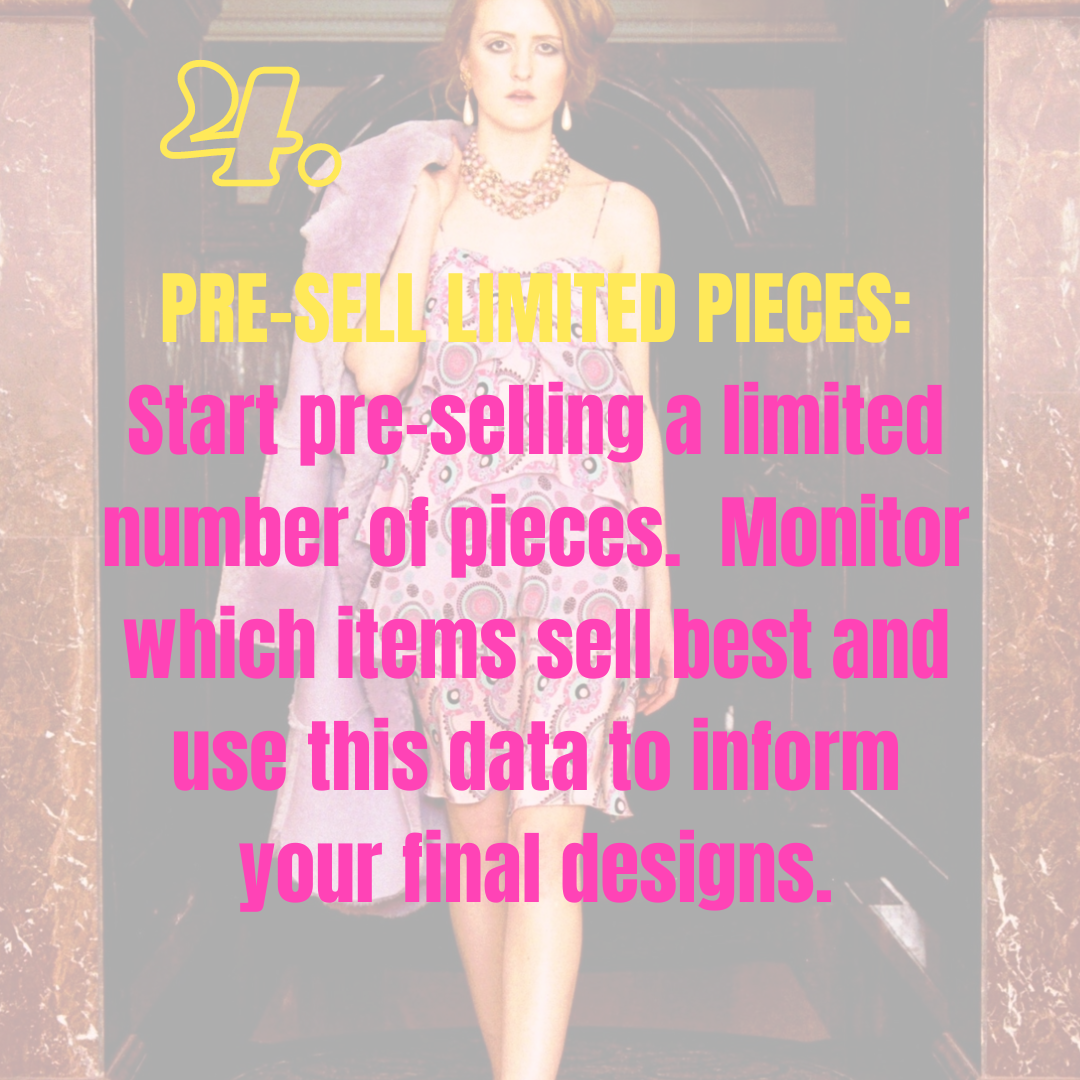
4. Pre-Sell Limited Pieces: Once you’ve gathered feedback from your images the next step is to start pre-selling a limited number of pieces. This approach a...
Fashion Entrepreneurs Academy students showed during London Fashion Week
SHOWCASE YOUR COLLECTION DURING FASHION WEEK
Even if you are just starting out!
Have you always dreamt of showing your fashion collection at fashion week….
Well…. Some of the designers in Fashion Entrepreneurs Academy experienced the esteemed opportunity of showcasing their collections during Fashion Week in February after just a few months in the programme.
Most were starting from scratch and some hadn’t even gone to fashion school but this is what they achieved.
Lotte said she loved being part of the showrooom and that it was an “amazing unreal experience”…..
Natasha said she "felt lucky to be mentored by [yours truly] in Fashion Entrepreneurs Academy" …
Tiffany said "it was a great experience". She "loved talking to press and buyers", who all loved her collection, and she finally "felt like a fashion designer" and entrepreneur!
Our spotlight designer even received celebrity treatment from a barrage of fashion press.
In less than 6 months you too could experience this when you become a mem...
Jane McMillan

Jane McMillan
Founder of Fashion Entrepreneurs Academy
Jane McMillan is a fashion launch architect and consultant living in London. Her Mac Millan brand gained celebrity clients including a former member of the British Royal Family and her work has been shown in editorial features such as Vogue, Marie Claire, Elle, In Style, Glamour, Cosmopolitan, WWD, etc. and featured on several broadcast media including Channel 4 and the BBC. For over a decade, Jane's collections were showcased internationally, appearing on the official catwalk schedule at New York Fashion Week in Bryant Park, the British Fashion Council's Designer Exhibition, On|Off catwalk shows at London Fashion Week, and Tranoï Paris. For many years, Jane consulted for renowned fashion brands including Roland Mouret and Roksanda, while also serving as an Associate Lecturer at Central Saint Martins, where she mentored students who have since become some of the most sought-after names in London, Paris and other global fashion capitals. Today, Jane brings together her experience in luxury fashion, education and business to help independent fashion brands launch their collections, attract the right customers and grow to the next level.
Recent Newsletters